
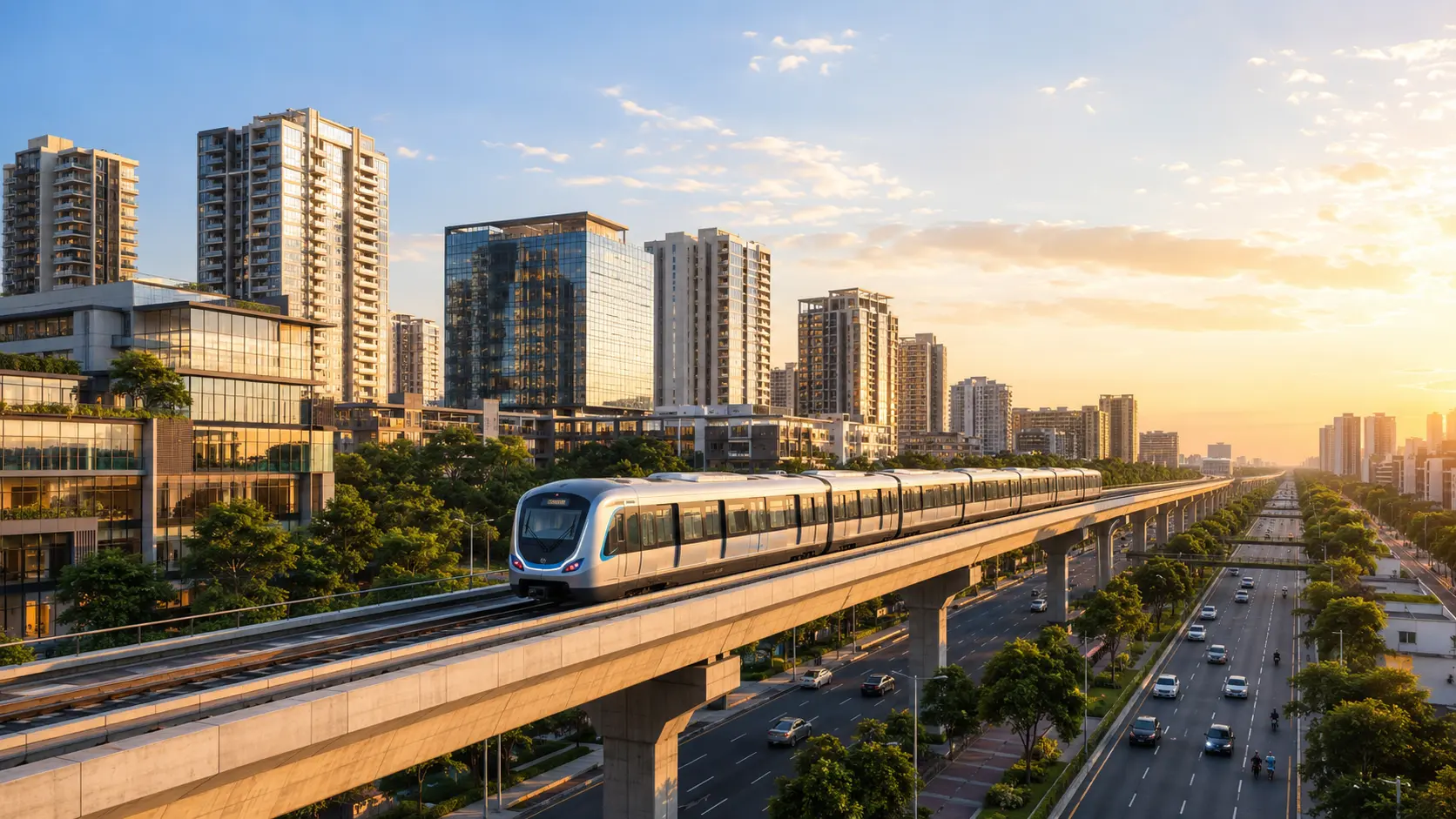
If you've been holding off on a property decision in Mohali, Zirakpur, or Panchkula because you're waiting to see what happens with the Chandigarh Metro — you're not alone, and you're not wrong to wait. Few infrastructure projects have hung over the Tricity real estate market for as long, or as inconclusively, as this one. Fourteen years after it was first proposed, the Tricity Metro is once again at the center of a very public tug-of-war, and in 2026 that fight has spilled out of planning committees and into Parliament.
For homebuyers and investors, this isn't just political theatre. A confirmed metro line has historically meant 20–30% value appreciation along its corridor in other Indian cities. An abandoned one means years of "soon-to-be-announced" pricing that never quite materializes. So where does the project actually stand, and what should you do about it?
A Decade and a Half of False Starts
The Chandigarh Metro's history reads like a cautionary tale in infrastructure planning. The idea first took shape in 2012, when the Delhi Metro Rail Corporation (DMRC) prepared the original Detailed Project Report (DPR) for the city. That plan proposed a 37-km track within Chandigarh, with extensions of 7.8 km into Punjab and 6.41 km into Panchkula, at an estimated cost of around ₹10,900 crore.
It didn't survive contact with reality. In 2017, the Union Home Minister's advisory committee rejected the DPR outright, declaring the project commercially unviable. Even Chandigarh's own Member of Parliament at the time, Kirron Kher, opposed it, arguing the city was too small to justify the expense.
That should have been the end of it. Instead, the project was revived in November 2022, when RITES (Rail India Technical and Economic Service) was brought in to re-plan the network from scratch. Citing the Tricity's combined population of roughly 3 million and worsening traffic congestion, RITES proposed a new 64.5-km network connecting Chandigarh, Mohali, and Panchkula. The Government of India gave it in-principle approval in March 2023, and momentum genuinely seemed to be building.
By July 2024, the Unified Metro Transportation Authority (UMTA) — a 23-member body — had approved an expanded scope, stretching the first phase from 64.5 km to 77 km, running from Parol in New Chandigarh all the way to Panchkula Extension in Sector 20. A finalised DPR followed that same month, and the proposed network now stands at three elevated-and-underground corridors covering 114 km in total — 89 km in Phase 1 and 25 km in Phase 2 — with an eye-watering estimated cost of ₹25,000 crore.
The Three Phase 1 Routes You Should Know
If the project proceeds as currently planned, here's what Phase 1 (slated for construction between 2027 and 2037) looks like:
- Paroul/Sarangpur, ISBT Panchkula to Panchkula Extension — roughly 30 km
- Rock Garden to ISBT Zirakpur, via the Industrial Area and Chandigarh Airport — roughly 34 km
- Grain Market Chowk (Sector 39) to Transport Chowk (Sector 26) — roughly 13 km
Phase 2, which isn't expected before 2037, proposes extending the network further — from Airport Chowk to Manakpur Kallar, and from ISBT Zirakpur to Pinjore. Inside Chandigarh's core sectors (1 to 30), the line is planned to run underground to preserve Le Corbusier's original architectural vision for the city; once it crosses into Mohali, Zirakpur, or Panchkula, it's expected to rise onto elevated, pillar-supported tracks — a cheaper and faster build.
On funding, the formula that's been agreed on splits costs three ways: 20% from the state governments, 20% from the Centre, and the remaining 60% from a lending agency.
Then, in January 2026, the Project Hit a Wall
Just when things looked like they were finally moving, the project ran straight into its most senior skeptic yet. Chandigarh UT Administrator and Punjab Governor Gulab Chand Kataria publicly threw cold water on the entire plan. Speaking at a press meet at the Chandigarh Press Club, Kataria said the city should not be excavated for a system that may not be financially viable, and directed the engineering department to study metro models in other cities and evaluate their profitability before any decision is taken.
Kataria didn't stop at raising doubts — he offered an alternative framing entirely, proposing that the network be extended to distant cities like Ambala and Rajpura rather than being confined to the Tricity, and warning against creating a financial burden similar to the struggling Jaipur Metro.
This is, in plain terms, the single biggest threat the project has faced since its 2017 rejection. When the person ultimately responsible for approving and funding Chandigarh's share of the project starts questioning its basic viability, "in planning" can very quickly become "shelved" again.
Parliament Pushes Back
The story didn't end there. Two months later, in March 2026, the project resurfaced in the Rajya Sabha. BJP MP Satnam Singh Sandhu raised the issue through a Special Mention during the Budget Session, demanding the Union government fast-track a comprehensive Metro rail network for the Tricity on a priority basis, with reports indicating Congress representatives were supportive as well — a rare instance of cross-party agreement on the issue.
Sandhu didn't lean only on traffic complaints to make his case. He told the Rajya Sabha that the Tricity is growing at a compound annual growth rate of 8.02%, with its population projected to surpass 40 lakh by 2041 — a demographic trajectory he argued makes a mass rapid transit system not optional, but inevitable.
So as of mid-2026, you have the Chandigarh UT Administrator questioning whether the project should happen at all in its current form, and members of Parliament from multiple parties publicly pressuring the Centre to accelerate it. The project remains stuck in what reporters have called "bureaucratic limbo," now in its fourteenth year since conception.
Why the Hesitation? It's Not Just Politics
It's worth taking Kataria's concerns seriously rather than dismissing them as obstruction. The skepticism is rooted in genuine financial-viability questions:
- The cost has nearly doubled. What started as a ~₹10,900 crore plan in 2012 is now estimated at ₹25,000 crore — and large infrastructure projects in India have a well-documented history of further cost escalation between DPR approval and actual completion.
- Ridership math is uncertain. Unlike Delhi or Mumbai, the Tricity doesn't have the population density that typically makes metro economics work without heavy, ongoing subsidy.
- Comparable cities offer cautionary examples. Kataria's specific reference to the Jaipur Metro — a system that has struggled with low ridership relative to its cost — wasn't a throwaway line; it's the central argument against rushing into a similarly sized commitment here.
- Funding still depends on multiple governments agreeing. With Punjab, Haryana, and the Centre all expected to contribute, and Haryana's share having previously held up DPR progress, the project's funding pipeline has a track record of friction even when everyone agrees on the need.
None of this means the metro won't happen. It means the timeline is genuinely uncertain in a way it wasn't six months ago, and that matters enormously for anyone making a buying decision today.
What This Means for Your Property Investment
Here's the practical reality for buyers and investors weighing decisions in 2026:
Don't buy purely on metro speculation.
Developers and brokers along the proposed corridors — particularly around Zirakpur, IT City, and Panchkula Extension — will inevitably use "metro-adjacent" as a selling point. Given that the earliest realistic construction window is 2027–2037, and that the project's fundamental approval is currently being re-examined at the highest administrative level, treating "near the metro route" as a guaranteed value driver right now is premature.
Connectivity fundamentals still hold regardless of the metro's fate.
The roads, the airport, and the IT corridor growth that have driven Mohali's 60–80% price appreciation over the past five years aren't contingent on the metro materializing. If the metro happens, it adds upside. If it doesn't, the underlying growth drivers — airport proximity, IT City expansion, improved highway connectivity — remain intact on their own merits.
Watch for two concrete signals before treating the metro as "priced in." First, a clear resolution of the UT Administrator's viability review — either a green light following the cost-benefit study he's ordered, or a formal scaling-back of the plan. Second, actual land acquisition activity, which historically only begins once funding is locked in, not merely approved in principle. Both would be far more reliable markers than route maps alone.
If you're buying for the long term, the macro case remains strong even amid the uncertainty.
A Tricity growing at 8% CAGR annually, with population projected to cross 40 lakh by 2041, faces a traffic and mobility problem that has to be solved one way or another — whether through this specific metro plan, a scaled-down version, or alternative mass transit. Long-horizon investors aren't betting on one project; they're betting on a region that will need to solve this problem regardless of which administration finally signs off.
The Bottom Line
The Chandigarh Metro is simultaneously closer to reality than it's ever been — with a finalised DPR, an approved 77-km route, and vocal Parliamentary backing — and facing its most credible institutional resistance since the 2017 rejection. Both things are true at once, and that's exactly why this is a story worth tracking rather than a settled fact to bake into your investment thesis.
For now, the smartest approach is to evaluate Tricity properties on their existing fundamentals — connectivity, developer credibility, rental demand, and infrastructure that's already built rather than promised — and treat any eventual metro confirmation as a bonus, not a foundation.
We'll be tracking this story closely on The Tiara as it develops. If you're actively exploring properties in the Tricity, platforms like Acquire Estate and 99acres are useful starting points for browsing current listings across Mohali, Zirakpur, and Panchkula while you watch how this plays out.