
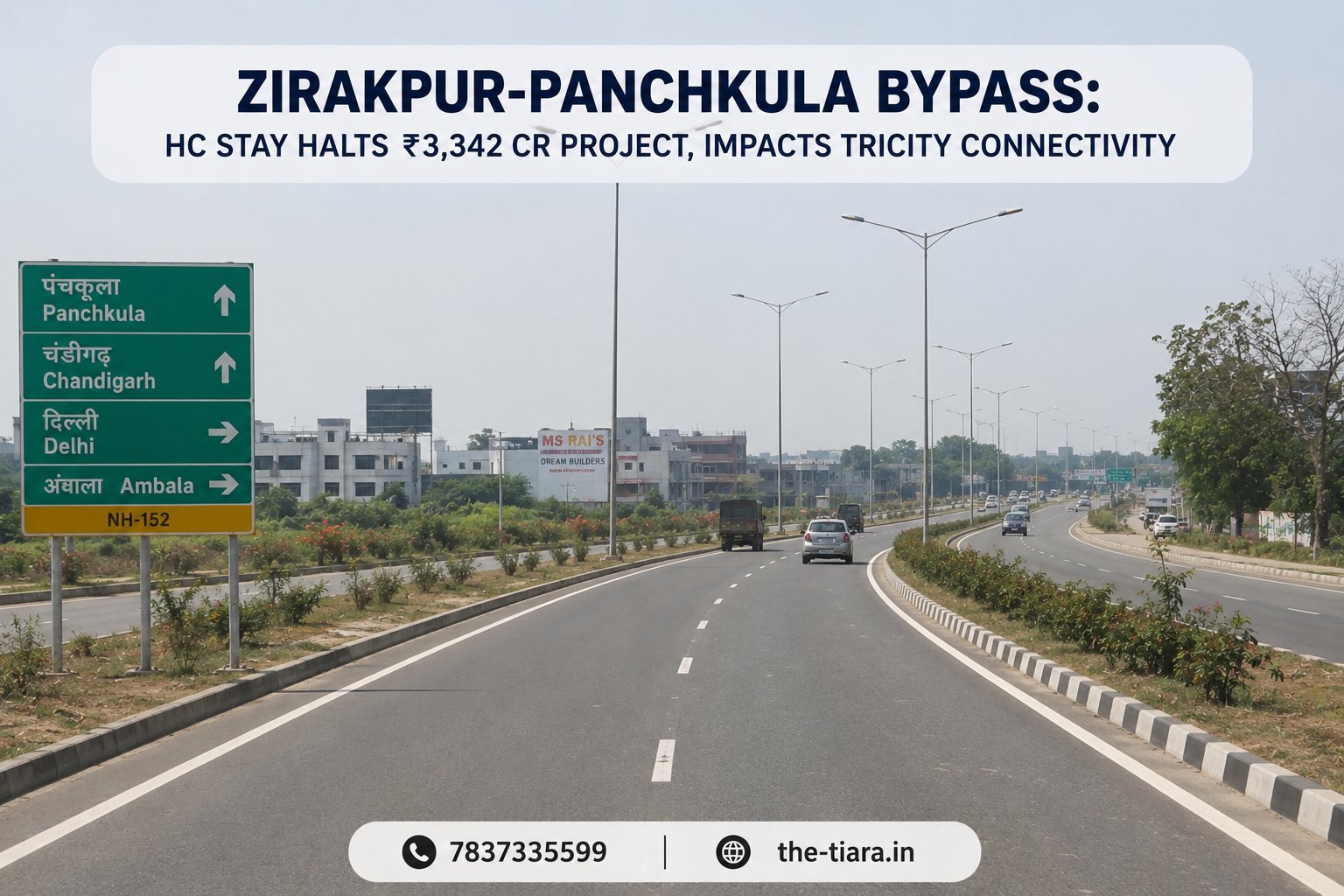
The Judicial Halt That Put the Tricity's Biggest Road on Ice
Unpacking the HC Stay on the Zirakpur-Panchkula Bypass - Roots, Repercussions & the Road Back
₹3,342 Cr Combined Project Value | 19.2 km Bypass Length | 2,790 Trees in Dispute | 17 : 1 Replanting Commitment |
On May 25, 2026 - just days after the last remaining bureaucratic lock was finally sprung - a Public Interest Litigation triggered a High Court order that froze the Zirakpur-Panchkula Bypass in its tracks. What follows is everything you need to understand about how this happened, what it costs and where it goes from here.
I. Gridlock Nation: The Daily Ordeal That Built the Case for a Bypass
Ask any commuter who navigates Zirakpur between 8 and 10 in the morning and the answer is always the same: a slow, horn-filled, fume-choked crawl through junctions never designed to carry this kind of load. Zirakpur sits at the crossroads of some of the busiest national highway corridors in northern India - NH-44, NH-205A, NH-152 - and every vehicle heading from Delhi, Ambala or Patiala towards Chandigarh, Shimla, Panchkula or Baddi must navigate its narrow urban grid to get there.
This is the wound the Zirakpur-Panchkula Bypass was always meant to heal. A 19.2-kilometre, six-lane, fully access-controlled expressway that carries all through-traffic clean over and around the congested cores of Zirakpur and Panchkula - not through them. Conceived under the Bharatmala Pariyojana and entrusted to the National Highways Authority of India (NHAI), it represents a Rs 1,878-crore investment in a corridor that doubles as both an urban relief valve and a national security asset.
Its northern anchor sits beside Chandigarh International Airport - which operates in tandem with an Indian Air Force Station. Its southern terminus connects to Chandimandir Military Station in Panchkula, headquarters of the Indian Army's Western Command. The road between those two points is not merely infrastructure. It is strategic geography.
| Project Attribute | Specification |
| Full Project Name | Zirakpur-Panchkula Bypass + Greenfield Spur |
| Bypass Stretch | 19.2 km - 6-lane, access-controlled expressway |
| Companion Spur | 10.3 km Greenfield Corridor |
| Bypass Investment | Rs 1,878 Crore (contract: Rs 1,380 Cr - RKCPL Ltd, 2-year deadline) |
| Spur Investment | Rs 1,464 Crore (contract: Rs 603 Cr - Ceigall Infra, 18-month deadline) |
| Combined Ecosystem | Approx. Rs 3,342 Crore |
| Northern Origin | Chandigarh International Airport / IAF Station |
| Southern Terminus | Chandimandir - Western Army Command HQ, Panchkula |
| Programme Authority | NHAI under Bharatmala Pariyojana |
| Forest Clearances | Stage-I & Stage-II - obtained from MoEF&CC, Govt. of India |
| Defence Land Cleared | 2.7461 acres at Chandimandir (approved May 2026) |
| Elevated Span | 6.195 km - designed specifically to reduce tree felling |
II. The Last Lock Opens - Then the Court Steps In
The project's regulatory journey reads like an endurance test. Six years of waiting on forest approvals. Multiple tender postponements. Complex land acquisition disputes. A Ministry of Defence negotiation that stretched across months before 2.7461 acres of army-controlled land at Chandimandir were finally released in May 2026.
For the first time in the project's existence, every single clearance was in hand. The machines were ready. Construction was imminent.
Then, on May 25, 2026, a Public Interest Litigation reached the Punjab and Haryana High Court - and the bench responded with an order of sweeping scope: a blanket prohibition on the felling of any trees anywhere in Haryana without the court's express, case-by-case approval. The PIL cited approximately 5,000 trees in the path of the bypass. NHAI, in its formal reply to the court, stated that the actual count of forest trees proposed for removal stood at 2,790 - a figure backed by statutory clearances at every level.
COURT DIRECTIVE AT A GLANCE
Order: Blanket stay on all tree felling across Haryana - no removal without HC permission Trigger: Public Interest Litigation filed before the Punjab & Haryana High Court PIL's Claim: ~5,000 trees to be felled along the bypass corridor NHAI's Response: 2,790 forest trees - all covered by valid MoEF&CC clearances Current Status: Case listed for next hearing; NHAI's detailed reply on record |
III. Counting the Canopy: What the Numbers Actually Say
At the core of this dispute lies a question that ought to have a clear, publicly verifiable answer: how many trees are genuinely at stake? The gap between the PIL's figure and NHAI's own count has become one of the case's most contested flashpoints.
Here is NHAI's complete environmental position as filed before the High Court:
| Environmental Indicator | NHAI's Declared Position |
| Forest Trees Proposed for Removal | 2,790 (the PIL cites ~5,000 - no single verified public count exists) |
| Statutory Forest Clearances Held | Stage-I and Stage-II from MoEF&CC, Govt. of India - both obtained |
| Wildlife Review | Mitigation plan assessed and approved by Wildlife Institute of India, Dehradun |
| Compensatory Trees (Statutory Schemes) | 27,770 trees |
| Avenue Plantation Along Route | 12,000 trees |
| Shrubs Within the Corridor | 7,992 shrubs |
| Total New Vegetation Committed | 47,762 - over 17 times the trees proposed for removal |
| Financial Deposits | Net Present Value and afforestation funds deposited with MoEF&CC |
| Design Adaptation | 6.195 km elevated section to keep ground-level tree loss to a minimum |
The arithmetic is straightforward: for every tree proposed to come down, more than seventeen will go in. The elevated corridor - an engineering choice that added considerably to the project's cost - reflects NHAI's stated intention to minimise ecological disruption wherever structurally possible.
COMPLIANCE CHECKLIST
Statutory forest clearances secured? YES - Stage-I and Stage-II from MoEF&CC. Replanting formally funded and committed? YES - 47,762 plantings at 17:1. Independent wildlife assessment completed? YES - Wildlife Institute of India, Dehradun. |
IV. The Voice of Dissent: Why the Petitioners Have a Point
Before dismissing the PIL as a procedural nuisance, it is worth pausing to understand the concern it represents. The Shivalik foothills bordering Panchkula and the Morni Hills range are not merely scenic. They are ecological infrastructure - regulating water, filtering air, anchoring soil and sustaining biodiversity in a region that is otherwise thoroughly urbanised. Losing stretches of mature forest to a highway is not the same as losing a row of roadside saplings.
The petitioners' deeper anxiety - one shared by many urban ecologists - is that compensatory plantation programmes in India routinely fail to materialise at the promised scale, within the promised timeframe, in the promised ecological quality. A sapling registered on paper and a thriving tree in the ground are not the same thing. The court system is, for many citizens, the only available mechanism for holding those promises accountable.
The data discrepancy sharpens that concern. A gap of over 2,000 trees between the PIL's count and NHAI's count does not, by itself, imply bad faith - it may reflect genuinely different methodologies or definitions of 'forest tree'. But it does mean there is no single transparent, independently verified, publicly accessible number. That absence is a governance failure and the HC is right to press for clarity before giving a green signal.
The broader scope of the stay order - covering the entire state of Haryana, not just this project - also signals that the court's concern extends beyond a single highway. It reflects a pattern the bench evidently considers worth examining system-wide.
V. Beyond the Traffic Jam: The National Security Dimension Nobody Talks About
A Defence Artery Hiding in Plain Sight
Strip away the traffic statistics and the real estate commentary and what remains is a corridor that connects an Indian Air Force Station to the headquarters of the Indian Army's Western Command - in a border state where rapid military mobilisation is not a hypothetical scenario.
The Ministry of Defence's decision to release 2.7461 acres of army land at Chandimandir specifically for this project is not a routine administrative act. It is a statement of institutional priority. Defence installations do not part with land unless the strategic benefit justifies it. Currently, every movement between these two establishments passes through densely built residential and commercial areas with multiple signalised junctions. In an emergency, that matters.
The Commuter's Arithmetic
For the millions who live and work across the Tricity, the bypass is less about national security and more about the 25 minutes lost every morning at Zirakpur's Gol Market chowk. Peak-hour traffic at Zirakpur's key junctions has become a near-total standstill - a problem compounded by the fact that long-haul trucks heading to Shimla, Baddi and Chandigarh from Delhi and Ambala have no alternative route. The bypass eliminates that problem entirely for through-traffic, redirecting it onto an access-controlled expressway that does not pass through a single inhabited intersection.
The secondary benefits follow: lower fuel burn from reduced idling, measurably cleaner air in the affected neighbourhoods, faster ambulance transit times to Fortis Mohali and PGIMER Chandigarh and meaningfully reduced road-accident risk at the most congested points.
The Compounding Cost of Inaction
Delay is never free. The Greenfield Spur component of this project is the proof: originally estimated at Rs 940 crore when first conceived in 2020, its projected cost has since risen to Rs 1,464 crore - a 56% increase over five years. Material inflation, labour costs and financing charges compound silently with every passing quarter. The HC stay may be legally necessary; it is not financially neutral.
VI. Six Years, Six Hurdles: The Delay Chronicle
| Timeline Marker | What Happened |
| 2020 | Bypass conceived under Bharatmala Pariyojana; project enters design phase |
| 2020 – 2024 | Prolonged clearance cycle: forest approvals, land acquisition, bureaucratic queues |
| June 2025 | NHAI issues fresh tenders; technical bid openings deferred six consecutive times |
| January 2026 | Final Stage-2 Forest Clearance received from MoEF&CC - the last major regulatory gate |
| January 29, 2026 | Technical bids opened; contracts awarded to RKCPL Ltd and Ceigall Infra Projects |
| February 2026 | Central Government approves the Rs 1,464 crore Greenfield Spur |
| May 2026 | Ministry of Defence clears 2.7461 acres of army land at Chandimandir |
| May 25, 2026 | Punjab & Haryana HC issues blanket stay on all tree felling in Haryana (PIL trigger) |
| Present | Project halted; NHAI reply filed; case listed for next HC hearing |
VII. The Ripple Effect: Who Absorbs the Pain While the Project Waits?
A court order halting a highway project has consequences that extend well beyond the construction site. The pause radiates outward - touching commuters, patients, freight operators, retailers and urban planners alike.
Morning Commuters and Emergency Responders
• Zirakpur's worst chokepoints - Gol Market, Kalka Chowk, VIP Road - will continue to bleed time from every journey.
• Long-haul freight vehicles serving Shimla, Baddi and Chandigarh-bound destinations have no bypass alternative and will keep using city roads.
• Vehicular idling in Zirakpur and Panchkula's densely settled zones will sustain elevated air pollution levels.
• Emergency vehicles responding to PGIMER Chandigarh and Fortis Mohali will continue losing critical minutes at peak-hour junctions.
Industry and Commerce
• Logistics firms serving the Baddi-Barotiwala-Nalagarh industrial corridor will continue absorbing unpredictable freight delays.
• Planned commercial developments near anticipated bypass interchange locations will remain in a holding pattern.
• Retailers and builders along the NH-152 belt will defer expansion and launch decisions until clarity returns.
The Ring Road Equation
There is a larger infrastructure ambition behind this bypass: the 244-kilometre Tricity Ring Road, a master-plan initiative designed to loop Chandigarh, Mohali, Panchkula, Zirakpur, Ambala and the international airport into a single, seamlessly connected orbital. This bypass provides 19.2 of those 244 kilometres. Without it, the ring stays broken - and the network-wide efficiency gains that the full loop would generate remain out of reach.
VIII. The Property Equation: Sentiment, Signals and What Smart Buyers Should Do
No infrastructure story in the Tricity lands in isolation. Every significant highway announcement shifts the property map - and the bypass is no exception. At Homziio, tracking these linkages is not an occasional exercise; it is what two decades of market intelligence looks like in practice.
The Value Trajectory Before the Stay
• Residential plots and apartments within 1–2 km of proposed bypass exits in Zirakpur were registering speculative appreciation of 12–18% through 2025–26.
• Panchkula Sectors 26–28, Dhakoli and the broader New Panchkula fringe were drawing sustained institutional investor attention as bypass-corridor bets.
• Commercial land near proposed interchanges along the Chandigarh Airport Road belt was attracting asking prices of Rs 17,000–Rs 20,500 per sq. ft.
• Premium housing projects in Mohali Sectors 66–70 and Zirakpur's VIP Road corridor were projecting 15–20% uplift on bypass completion.
How the Stay Changes the Calculation
• Investors who bought in anticipation of bypass-driven appreciation will likely shift into a reassessment mode for the near term.
• Fresh launches in Zirakpur and along the NH-152 corridor are expected to be pushed back by one to two quarters.
• Institutional capital earmarked for Tricity commercial assets may temporarily pivot toward Gurugram or Noida while the HC matter resolves.
HOMZIIO MARKET INTELLIGENCE - WHAT TO DO NOW
Buying for self-occupation? The HC stay is a timing event, not a project cancellation. NHAI holds every required clearance. Buy on location fundamentals - the bypass is a bonus that will arrive, not disappear.
Investing for capital appreciation? Sentiment plateaus are entry windows. Ready-to-move inventory at current stabilised prices offers bypass-corridor upside exposure without launch-risk. Always consult a Homziio advisor before committing capital.
Disclaimer: Past performance of infrastructure corridors is not a guarantee of future returns. |
IX. Two Legitimate Claims, One Contested Corridor
Neither side in this debate is manufacturing its argument. The case for the bypass is strong. So is the case for the trees. That is precisely what makes this difficult.
PROGRESS ARGUMENT → Congestion-free defence logistics between IAF Station and Western Army HQ → 17 new plantings for every tree removed - 47,762 against 2,790 → All statutory approvals in hand - Stage-I and Stage-II from MoEF&CC → Elevated design across 6.195 km specifically to reduce ecological footprint → 56% cost inflation already absorbed - further delay compounds taxpayer burden → Ring Road's 244-km vision incomplete without this 19.2-km segment | ECOLOGY ARGUMENT → Shivalik foothills form the Tricity's last meaningful natural forest buffer → Planted saplings cannot replicate the ecological function of mature trees → Tree-count discrepancy (5,000 vs 2,790) signals a transparency failure → Approval sets a template normalising future forest diversion in Haryana → Urban heat, flooding and air quality already under pressure in Panchkula → Courts are the last check before ecologically irreversible decisions are made |
The resolution that serves everyone's interests best is not prolonged litigation - it is a time-bound, court-supervised independent tree census to settle the count dispute; a binding, quarterly-reported compensatory plantation audit; and a conditional clearance that allows construction to proceed under monitored ecological compliance. Both the canopy and the commuter can be protected. But not through an open-ended stay.
X. Probable Paths Forward: Reading the Legal Landscape
| Outcome Scenario | Assessment | Why |
| HC grants conditional clearance with plantation monitoring | Most Likely | Proportionate to NHAI's comprehensive statutory filings |
| HC vacates stay outright after compliance review | Likely | NHAI's legal position is well-documented and strong |
| HC orders independent third-party tree census | Possible | Directly addresses the core data dispute |
| Litigation extends 6–12 months pending systemic review | Low-Moderate | Possible if HC broadens scope to state-wide forest governance |
| Project permanently blocked or cancelled | Very Unlikely | Valid MoEF&CC clearances make full cancellation legally untenable |
The legal fundamentals favour NHAI. Both levels of forest clearance are in hand. The ecological mitigation plan has been reviewed by an independent national authority. Afforestation funds have been deposited. The project design has already absorbed the cost of minimising tree loss through elevation. A proportionate judicial response would be conditional clearance - not an indefinite freeze.
XI. Homziio's Perspective: What Two Decades of Watching This Market Has Taught Us
Since 2004, Homziio has been present through every major infrastructure announcement, delay and eventual delivery across the Tricity. We have watched projects that seemed permanently stalled eventually break ground. We have also watched projects that moved fast encounter consequences they had not anticipated. The Zirakpur-Panchkula Bypass falls squarely into the first category.
This is one of the most thoroughly documented and legally fortified projects in the region's infrastructure history. It has cleared barriers - environmental, bureaucratic, military - that have stopped lesser projects permanently. A PIL-triggered stay, significant as it is, sits within the normal arc of large Indian infrastructure projects. History is consistent: well-cleared NHAI projects proceed. The only variable is when.
Our counsel to buyers, investors and developers watching this space: maintain your position on fundamentals, avoid making decisions driven by short-term sentiment swings and stay close to verified information. The Tricity's structural strengths - its governance framework, proximity to Delhi-NCR, quality of life credentials and expanding infrastructure pipeline - are not diminished by a court order. They remain as compelling as they were the day before the stay was issued.
The Verdict of History Is Still Being Written
What happens in the Punjab and Haryana High Court over the coming weeks will determine whether this corridor opens within its contracted timeline - or whether the Tricity endures another chapter of waiting. Either way, the project's ultimate destination is not in doubt.
The court's intervention is not the enemy of infrastructure. It is, at its best, the mechanism by which infrastructure is held accountable to the communities it is meant to serve - including the forests those communities depend on. The task now is to ensure the proceedings move with the urgency the situation demands: a verified tree count, a binding plantation commitment and a time-bound conditional clearance that allows both the natural environment and the built environment to be protected.
The 2,790 trees at issue are not standing in the way of progress. They are part of the landscape that progress must learn to navigate with greater transparency and greater care. When that is achieved - and the bypass is eventually built - it will carry a more valuable inheritance: proof that Tricity's infrastructure ambitions and its ecological conscience can coexist.
Homziio will be with you for every development between now and that moment.